From a small practice to a large organisation
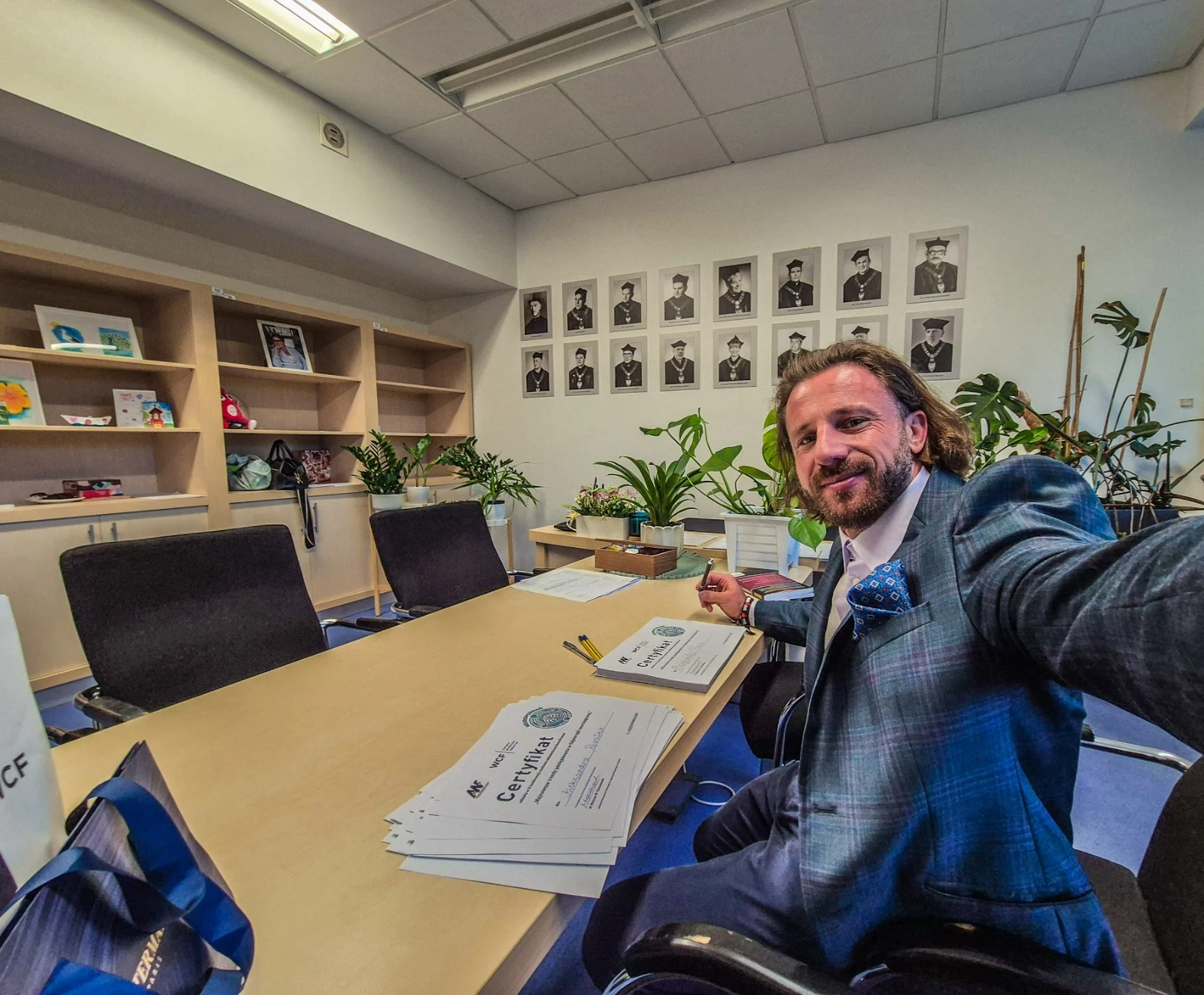
When we are in the midst of an organisation, putting our knowledge and energy into making it work every day, we do not notice how much has changed over the years. That change did not happen in a single day. There was no moment when a small business suddenly became a large organisation. There were hundreds of smaller decisions, new people, new places, new contracts, new responsibilities and problems that simply had not existed before. Today, looking back on that journey, I can see its scale.
At first, I worked alone: providing therapy, settling payments for services, answering calls from patients and booking appointments, preparing a tender for the National Health Fund and drawings of treatment rooms for the contractor, reading and implementing healthcare regulations, and keeping an eye on finances. As more patients placed their trust in me and their numbers grew, I offered my wife a job. Initially, she handled service settlements and answered phone calls. As the number of patients continued to grow, Joanna also began providing physiotherapy in patients’ homes.
Then came the first receptionist, more people, managers, HR, accounting, administration, coordinators and teams responsible for further areas of the organisation. Our medical activities grew alongside them. We started with one contract for home physiotherapy. Today, WCF comprises around 30 locations, around 20–23 contracts for home and outpatient physiotherapy, four day units, two primary care practices and private services. Around 1,500 patients receive rehabilitation, while around 15,000 patients are under the care of our primary care practices. Behind all this is a team of several hundred people.
A handyman as a measure of scale
For me, however, one of the clearest symbols of this change is not the number of contracts or employees, but having our own handyman. Once, while visiting my father at the hospital, I thought that one day I would like to run a company large enough to employ someone who would have a full day's work repairing, installing, transporting and keeping our premises in good condition. At the time, that seemed like the sign of a truly large company. Today, we have that person.
Paradoxically, it is these small things that sometimes make me feel the scale of what we have built more clearly than the numbers do. A company must already be a substantial organisation if it needs its own HR, accounting, finance, marketing, IT and legal teams, as well as people responsible for quality, safety and investment.
When growth creates organisational debt
As the organisation grows, however, a problem emerges that I think about increasingly often: organisational debt. An organisation can grow faster than its structure for a long time. We can win new contracts, hire people, open locations and add services while relying on individual commitment to compensate for gaps in the organisation.
Someone remembers, someone reminds, someone checks, someone knows whom to call, and someone takes on one more task. For a while, it works – especially when you have excellent, responsible people. The problem appears when we try to apply a way of working suited to a few dozen people to an organisation of several hundred.
Commitment needs a system
At some point, commitment alone is no longer enough. We need structure, good managers, the right people in the right roles, clearly defined responsibilities and decision-making authority. We need measures, standards and processes. Not to create more bureaucracy, but because at a larger scale an organisation cannot depend on the memory and goodwill of a few exceptionally committed people.
This is one of the most important lessons I have learned from building and developing WCF: a system is not the opposite of commitment. A good system helps us make better use of people's commitment. If the most dedicated employees are constantly filling organisational gaps, their energy goes into firefighting instead of development. The system's role is to create conditions in which people can focus on where they truly add value.
The right people are not enough
For years, I felt close to Jim Collins's approach: first the right people, then the direction. Today, I understand that principle a little differently. Finding the right person is no longer enough. We also need to create an organisation where that person knows what they are responsible for, what authority they have, where the limits of their decisions lie and which decisions they will be accountable for. This is also a matter of respect for the people who choose to work with us and for us.
Even the best people cannot keep delivering good results for years within a poorly designed organisation.
The leader's role changes with scale
The leader's role also changes with scale. With a handful or a few dozen people, you can still do many things personally: remember, check, intervene and understand most of the organisation's problems. With several hundred people, that becomes impossible and irresponsible. After all, as leaders we are responsible for our teams.
At that stage, a good leader is no longer primarily the person who solves the most problems personally. They are the person who builds an organisation capable of solving problems without their constant presence.
This requires trust, but also clarity about responsibility. If we give someone trust and responsibility, we must allow them to make decisions. We can measure results, monitor quality and discuss mistakes, but we cannot simultaneously take away their right to decide. Otherwise, responsibility exists only on paper.
The next stage requires a different approach to management
Looking at WCF's development, I can see that the greatest change is not simply the number of contracts, facilities, patients or employees. What is far more interesting is what that scale demands of the organisation and the people who manage it. The approach that brought us to one point may not be the one that takes us through the next stage.
That is why today we do not want to build WCF by giving our most committed people ever more tasks, or by believing that someone will always remember. We want to build an organisation where responsibility has a clear place, people understand their authority and boundaries, decisions are made at the right level, and processes and systems help people do their work well.
Because organisational growth is not simply more facilities, patients, employees and revenue. It must also mean growth in the organisation's ability to organise itself.
Perhaps this is one of the hardest moments in a company's development: understanding that an organisation built through people's immense commitment now needs an equally strong commitment to building its structure. In truth, I know that the work of building an organisation's structure never ends. When we are inside it, putting our knowledge and energy into making it work every day, we can fail to notice how much change is happening all the time.