Ironman Florianópolis, Brazil
Swim. Bike. Run.
I prepared really thoroughly for this race. Not because I had not trained before, but this time I arranged my plan and the logistics so that I could actually complete long training sessions.
For about a month, I had also been paying much closer attention to sleep. I tried to get more than seven hours regularly and take sleep hygiene seriously. In amateur sport, we often focus mainly on training and neglect recovery. Yet it matters enormously.
Perhaps that is why this was the first race where I was not tossing and turning until midnight beforehand. Of course, there were nerves and emotions, but by 9:20 pm I was simply tired. I had been going to bed earlier for several weeks, and my body had found its rhythm. The night before the race, I fell asleep around 9:30 pm and slept until 5:20 am. That may not sound remarkable to many people, but for me it was a very good sign that my body was ready to work.
Training, especially cycling, means many hours on the bike. Along the way, I have become very fond of podcasts, as the WCF team has already discovered. They are excellent company during long sessions.
Training itself and everything it brings – discipline, repetition, working on mental and physical weaknesses, dealing with difficult moments, making decisions and adapting to plans – are things I value deeply and continue to work on.
I especially love triathlon and long-distance racing because they also teach humility, patience and persistence. That determination to crawl, walk or run towards the goal, according to the abilities you have to accept. There is no room for excuses or brief displays of heroism.
As usual on trips like this, the first challenge was logistics. Huge thanks to my brother-in-law for easing the stress and helping me sort out the bike travel case.
Swim – 3.8 km
Average pace: 2:03 min/100 m
After a 30-minute delay and a long wait standing still, it was time to start. As ocean water tends to be, it was not particularly pleasant at first – the temperature was fine, but it was very salty. Onwards.
The following day was Children's Day, so I thought a great deal about my children. I swam without looking at my watch or checking the distance. Just doing my own thing.
There were waves, which I like. They make things more interesting.
After about 500 metres, I started to feel thousands of what seemed like tiny stones, beads or slippery creatures around me. Between my fingers, against my face, around my feet. It really unsettled me. Imagining that I might swallow one made it even less pleasant. There were thousands of them.
After the race, I read that enormous shoals of small fish, numbering hundreds of thousands, are common off the Brazilian coast. It was a real mental challenge. Perhaps that is why I got out of the water so quickly.
The transition went very smoothly. Probably mainly because it had been a long time since I had swum in water that warm. Usually, you come out cold and stiff, and removing the wetsuit, getting dressed and sorting out the equipment takes quite a while. This time, everything went exceptionally well.
Bike – 180 km
Average speed: 30 km/h
A fantastic course. Views, bends and changes of direction. I like it when something is happening, rather than riding 100 kilometres in a straight line.
The course was moderately difficult, with several demanding climbs that were particularly noticeable on the second lap.
I felt really strong. I changed my nutrition strategy: this time, every hour I ate two gels and a bar together. It worked very well.
Around kilometre 150, I felt foggy and sensed my energy dropping. Fortunately, it passed after a while, but I had to fight to maintain my pace for the rest of the bike stage.
This part hurt.
Maintaining an average of 30 km/h after 150 kilometres was a real challenge for me.
Another smooth transition. Drink, food and ready to run.
Run – 42.2 km
Average pace: 6:59 min/km
I started the run feeling reasonably good. My heart rate was low, but my legs made themselves felt immediately. There was no sense of lightness.
Again, I tried to avoid looking at my watch. If I did glance at it, I checked only my pace. I did not want to see the time or distance. That works very well for me. My mind loses its sense of time and distance, leaving just one task: keep running forward.
From around kilometre seven, things improved a little. On the one hand, I knew I had done the running work and was prepared. On the other, my legs were telling a different story.
I could not run any faster.
It was a constant battle in my head:
‘Run. No walking.’
Over and over.
On the third lap, I had to work hard mentally. On the fourth, even harder. My legs really hurt.
With about seven kilometres to go, I tried to speed up. I managed around 6:30 min/km, but for less than a kilometre. Then I returned to my own rhythm.
And that was OK.
When I finally turned onto the straight leading to the finish rather than another lap, I felt enormous relief. My watch still showed around a kilometre to go, but anyone who has competed in these races knows you never know exactly how much is left.
I had never experienced such a long finish.
For the first time, I had to run very cautiously and simply make it to the end. It was so close, yet still so difficult.
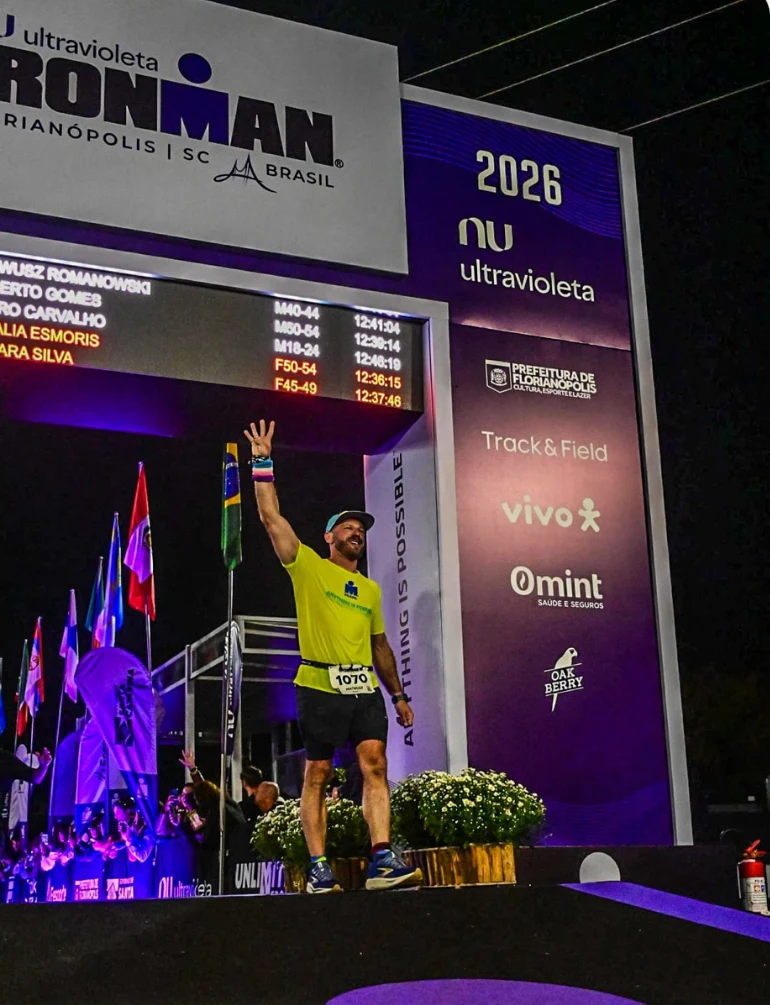
I crossed the finish line tired and aching, but above all happy and satisfied.
Thank you to everyone for your support and for willing that little dot forward. It really helps.
It was a very good race, after which I simply got on my bike and rode back to the hotel.
P.S.
Florianópolis will stay with me for more than the race. I do not think I had ever seen such intense colours: the blue sky, the lush green jungle and water shimmering from mint through turquoise to blue. At times, it even reminded me of Bianchi's colour.
Perhaps it will stay in my memory even more because the day after the race was Children's Day.
I thought about my children throughout the race – not only during the swim, but also on the bike and during the run. I imagined them watching that little dot on the screen and willing it forward.
‘Dad, you're flying!’
‘Dad, you can do it!’
‘Come on, Dad!’
Knowing they are rooting for me helps enormously. Even thousands of kilometres from home, they remain very close to me.
And not only them.
I know my friends were moving that dot across the screen too. That really helped when things started to hurt.
And my parents... they experienced the race very intensely, mainly, I think, because of the distance and because it was Brazil. In Poland, it was well past midnight – around half past one – and they were still awake. When it was all over, Mum called. She and Dad had been waiting and wanted to know how I felt.
Joanna sent me a ‘summary’, which I am including in the photos. Thank you for cheering me on.
You travel to the other side of the world and, in the end, discover that what matters most is not the kilometres, pace or result. What matters most is the people who are with you, even when an ocean separates you.
Because over a long distance, you never run entirely alone.